Languages I am learning
Here are some of the languages I am learning or shall learn.
The stars indicate grammar difficulty and richness of rewards, although both are highly subjective.
German (A2)
I’d like to read German literature and visit Germany someday. Besides, I associate it with fond memories of my old school. My German class’ teacher grew up in Germany, and she’d tell this young American audience all about the country — how they had a shopping street called Der Zeil, were blunt but loyal friends, earned money for recycling, ate white asparagus, made politically satirical parade floats for Karneval, and so on.
Experience
German grammar is relatively easy — at least, as an English speaker. The most difficult part of the language is probably the adjectives, which have three declensions. Memorizing the words’ genders (which are largely random) is tedious, but that’s all.Grammar

Germany has made major contributions to literature, science, history, and art. However, almost all Germans speak English, so the language isn't worth learning for travel.
If you're learning the language, at least in the U.S., prepare for a hundred Nazi jokes to wear out your ears...
Yields
Latin (B1)
I’d like to read Roman literature — Virgil, Juvenal, the works. I also find the sound and grammar beautiful.
Experience
As with other Romance languages, Latin’s verb system is complex. Five conjunctions, six tenses, a subjunctive, an active and passive voice; not to mention participles, gerunds, special tense rules with sensory verbs, and so on. It’s easy to confuse all the rules after learning so many. There are six cases for nouns, but that's honestly the easy part.
Classic literature in any language uses advanced grammar, but I can say that the hardest Latin poetry is substantially more complicated than the hardest English and Russian poems I know. Roman writers' syntactic wordsalad, only understood with a very solid grasp of grammar and literary techniques. There are also very few resources for understanding Latin idioms and misspelled words (which are common), so it's hard to learn Latin without guidance from a professor.Grammar
Latin is a matter of tradition. It connects you to not only the glorious days of Pax Romana, but to the humble monks of the Dark Ages, methodically preserving the ruins of the lost Empire; to the great Enlightenment thinkers and the French revolution; to Spinoza, Kant, Copernicus, to Victorian bohemians who lived beautifully and died tragically. It connects you Washington modelling America on the Roman republic, on "e pluribus unum." When you speak the language, when you feel ages upon ages weighing on your shoulders, millenia of war and peace, words passed from ear to ear tens of thousands of times. Latin is a long, long tradition now being forgotten in the modern world, where people care about what's fun more than what's noble.
There isn't much modern stuff to read in Latin, but whatever you do read will probably be high-brow and extraordinary, especially Vergil, who is an absolute genius. There are few languages where translations and original texts contrast as much as in Latin, whose words are like rich, gilded honey compared to the stiff hardtack of English. Sometimes I read Latin poetry without even knowing what it means -- Catullus 16, for example -- simply to appreciate the dulcet sound.
Yields
Russian (B1)
Almost all of my interests align with the strong suits of Russian culture – literature, classical music, art, ice-skating, ballet, and physics. I also happen to think Russian is the most beautiful language. I like the Slavic languages generally, but unlike the other ones, Russian’s spoken by many people.
Experience
The verbs are and always will be deeply annoying. There's a pattern to it, but the pattern is so complex that to fully grasp it, you'll need to spend years developing instincts for it. In the meantime, all you can do is memorize the general rules.
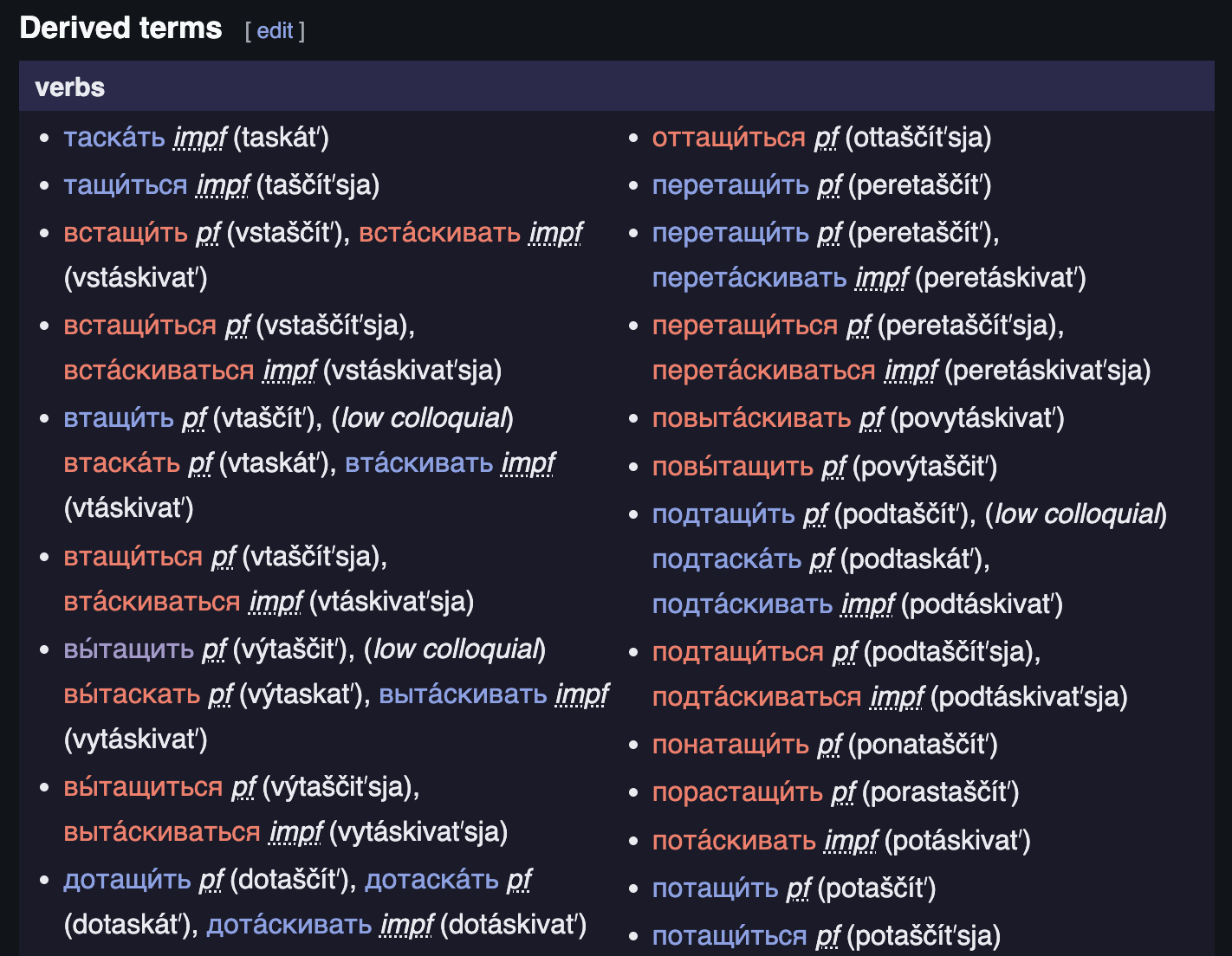
Most Russian websites only teach you to conjugate "-ать" and "-ить." They’re simplifying the language as to not intimidate foreigners, but I'll tell you the ugly truth. These rules don’t cover the immense multitude of verbs that end with other things: влечь, перевести, мыть, and so on. As somebody who’s reading Russian literature in the original, I memorized Zaliznyak’s sixteen-declension system, and whenever I’m learning a new verb, I look it up on Wiktionary, which uses this system. Others will call me a madman for my efforts, but I swear by my method.
Endings aren’t the only difficulty :) every verb has two forms: imperfective and perfective. And then there are verbs' "derived forms" (see right.) You know how in English, we have words with the same stems and different prefixes, like "compose", "propose", "transpose"? Russian experiences this, but to an extreme extent -- it's confusing to memorize.
There are some other challenges — when discussing dates and times in Russian, there are numerous tedious preposition rules. Russian words are also quite long.
Grammar
It is an abundant language in terms of resources. There are tons of YouTube channels and Quizlet/Anki decks you can use and large social media platforms exclusively using the language. Its yields are very rich, too -- whether you like science (especially physics), history, the arts, film, or literature, there will be some point where the language is useful.
I have heard stories online of people recieving comments about “supporting imperialism/the war” when they say they’re learning Russian. In my experience, though, pretty much everyone offline is normal about it. If anything, though, learning Russian may help in antiwar efforts — I know Ukrainian refugees that don’t speak a speck of English and need stuff translated into Russian, and if anything, I regret not learning the language earlier to help them. They must be very confused and lonely.
Yields
Ancient Greek (A1)
Just as with the other languages, I am learning this one to read, like a nerd; I find Greek philosophy and Hellenic paganism interesting. Finally, I just want another language with an alphabet my compatriots cannot put in Google Translate, so I can use it to write whatever I’d like.
Experience
I feel something strong about Greek; I don't know if it's love or hatred. A single grammar lesson from my textbook book takes hours. The verbs are overwhelmingly complex. There are six tenses, three voices, a subjunctive, an optative, and each verb has six principal parts.
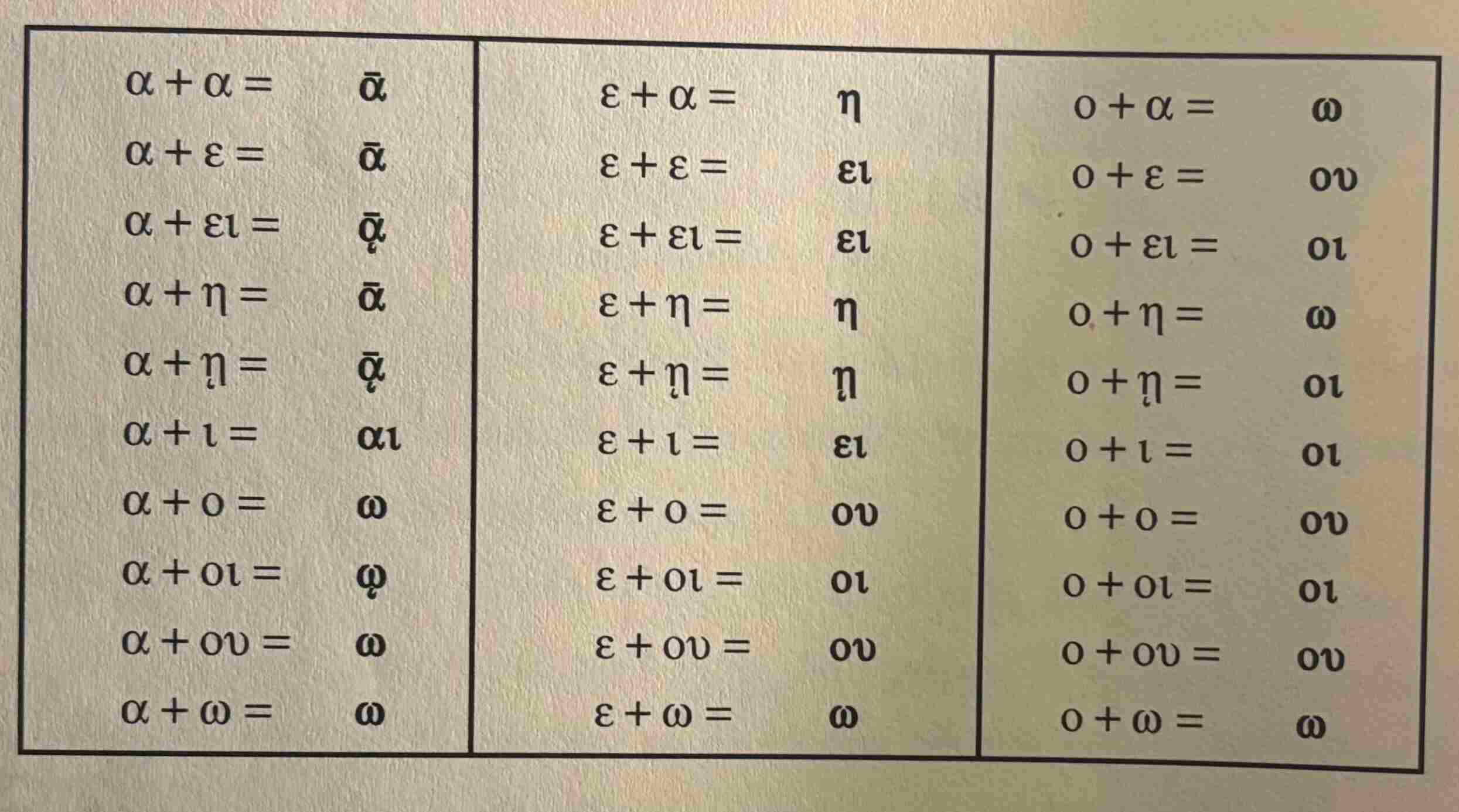
Ancient Greek in particular is quite picky about pronunciation. It's a pitch language, like Chinese, meaning there are set rules about the pitch of every syllable in a word. There are numerous rules and exceptions to rules about pitches, and that's not even mentioning the difficulty of "euphony", the Greek concept of blending letters together so they sound smoothly (see right for an example.)
There is then the issue of Greek vocabulary. If you learn languages that are part of the same family, or which influenced each other -- English and German, for example, it's easy because some words sound similar. However, unless you know Modern Greek, Ancient Greek will sound unlike any language you've ever known. There are also several dialects of Ancient Greek, and you'll have to learn all of them to have full access to Greek literature.I could go on and on about how tough this language is -- the syntax is confusing, memorizing vowel lengths is confusing, there are virtually no resources for study. Suffice to say it's just a bloodbath of a language, only for the truly dedicated.Grammar
Greek literature is masterful, and that is the main draw of the language. However, it is disappointingly rare anywhere else. Latin at least has a major role in Western history and philosophy; Greek’s only used for abstruse terms like “oligosaccharide.” If nothing else, speaking Greek is a cool party trick. I write Ancient Greek blessings and curses on my school’s whiteboards because it’s funny.
Yields
Old Church Slavonic (Not started)
Dead languages feel more magical. Languages nowadays, even difficult ones, are quite simple grammatically compared to historical ones -- there's something beautiful about learning something so multifaceted. Moreover, they were used by kingdoms and empires that have lain in the earth for hundreds of years, cold and still beneath the malls and CostCo Wholesales of modernity.
Page created April 13, 2024.